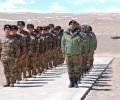
Chinese foreign ministry spokesperson Mao Ning told the media in Beijing on Monday that the two sides held an in-depth exchange of views on expediting the resolution of relevant issues.

'Disengagement is merely the first step in a lengthy process of arriving at a new normal along the LAC in Eastern Ladakh and the entire land boundary.' 'The Indian government should insist on the restoration of the status quo ante in Eastern Ladakh.'
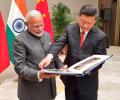
China's foreign ministry on Monday parried questions on a possible meeting between Prime Minister Narendra Modi and President Xi Jinping on the sidelines of the BRICS summit in Russia this week.
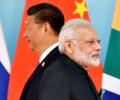
'The events of 2020 have actually put our relationship under exceptional stress.' What External Affairs Minister Dr Subrahmanyam Jaishankar told the All India Conference of China Studies on Thursday, January 28, 2021.

The situation along the Line of Actual Control (LAC) in eastern Ladakh is stable but sensitive and not normal, Chief of Army Staff General Upendra Dwivedi said on Tuesday on the dragging military standoff between China and India in the region.

India and China on Thursday vowed to redouble efforts to resolve the remaining issues in eastern Ladakh at the earliest and 'stabilise and rebuild' ties even as External Affairs Minister S Jaishankar conveyed to his Chinese counterpart Wang Yi during a meeting that the Line of Actual Control (LAC) must be respected.
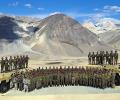
Her comments come a day after External Affairs Minister S Jaishankar said in Geneva that roughly 75 percent of the "disengagement problems" with China are sorted out but the bigger issue has been the increasing militarisation of the frontier.

Russia on Monday accused the US of "actively" exploiting the "contradictions" between India and China to its advantage and asserted Moscow and New Delhi accumulated mutual trust and confidence based on decades-old ties that would help the two sides to deal with the current geopolitical turbulence.

China on Thursday said the meeting between Prime Minister Narendra Modi and Chinese President Xi Jinping in Russia's Kazan on Wednesday carries a "great significance" as they reached an "important common understandings" to improve the bilateral ties.

China on Tuesday confirmed that it has reached an agreement with India to end the standoff between the two armies in eastern Ladakh.
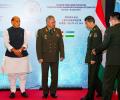
Singh conveyed to Li that India wants to improve relations with China but it can happen only after peace and tranquillity are restored at the border, the sources said.
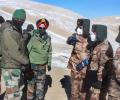
India and China on Tuesday agreed to hold the next round of the Senior Commanders meeting at an early date to achieve complete disengagement from all friction points in eastern Ladakh to create conditions for the restoration of normalcy in bilateral ties.

Prime Minister Narendra Modi on Tuesday conveyed to Russian President Vladimir Putin that India stands ready to provide all possible cooperation towards ending the Russia-Ukraine conflict and that dialogue and diplomacy is the only way to bring peace to the region.

Bagchi said this when asked to comment on remarks by a Chinese diplomat that the situation in the India-China border areas is stable.

The Army said Gen Pande witnessed Parvat Prahar exercise besides interacting with officers and troops deployed in the region. The exercise featured a display of operational capabilities by artillery guns and other key weapon systems.

Disengagement from the LAC will remain a chimera because China has given enough indications that the PLA will not move back any more. China has even deployed drones to monitor and deny any patrolling by Indian troops even in the buffer zones which are all in Indian Territory, explains Lieutenant General Prakash Katoch (retd).

Colombo seems to be veering to the middle path between China and the US on global matters, but in regional matters of strategic security, it is increasingly identifying with India, points out N Sathiya Moorthy.

China should deepen its defence ties with India, as the agreement reached by the two countries to resume joint military exercises still represented a 'low level of cooperation', the official media said on Wednesday.
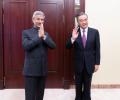
'We stress that the boundary issue shall not be linked with the overall bilateral relations. That is an important experience we have gathered through many years' effort to keep the ties moving forward

'Once we deal with the disengagement, there is the larger issue as both of us have brought a very large number of troops up to the border.' 'So there is what we call the de-escalation issue, and then there is the larger, the next step is really, how do you deal with the rest of the relationship?'

A broad consensus has been achieved by India and China on restoring the 'ground situation' along the Line of Actual Control (LAC) pursuant to talks, including for patrolling and grazing cattle in the traditional areas, Defence Minister Rajnath Singh said on Thursday.

'The muscularity of the last three years didn't bring any dividends and if anything, Chinese attitudes only hardened,' says Ambassador M K Bhadrakumar.

'Given China's past behaviour and their territorial claims, should we be sceptical regarding China's willingness to adhere to these agreements fully? The answer is yes.' 'As Ronald Reagan famously said in the context of the SALT talks, 'Trust, but verify!' India should also do the same.' 'This has already begun with foot patrolling, drones, satellite imagery and so on. India's military deployment did mirror China's and will continue to do so in the future.'
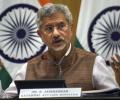
The last Indian external affairs minister to visit Pakistan was Sushma Swaraj. She had travelled to Islamabad in December 2015 to attend a conference on Afghanistan.

The Jaishankar-Wang talks came amid the dragging border row in eastern Ladakh that entered its fifth year in May.
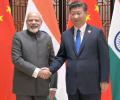
The Chinese and the Indian troops were engaged in a standoff for 73 days in Doklam.
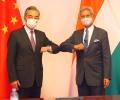
Jaishankar said full restoration and maintenance of peace and tranquillity in border areas was essential for the development of the bilateral ties.

The US remained "watchful" over developments along India's frontier with China as it cannot take its eyes off the regional security issues, a senior American official said on Wednesday against the backdrop of the over 29-month border standoff in eastern Ladakh that has significantly frayed ties between the two neighbours.

United States President Barack Obama on Tuesday warned time is running out to fight global warming but said the US was determined to act and that climate was the biggest issue in its ties with countries like India and China often blamed for the stalled talks.
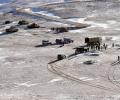
India and China to hold the 11th round of corps commander-level talks at Chushul in eastern Ladakh at 10.30 am on Friday that is expected to focus on disengagement of troops in remaining friction points, sources within the Indian Army said.

External Affairs Minister S Jaishankar is set to hold separate bilateral talks with his Chinese counterpart Qin Gang and Russia's Sergey Lavrov at a beach resort in Goa on Thursday on the sidelines of a conclave of the Shanghai Cooperation Organisation (SCO) amid rapidly evolving regional security situation.
The development comes after after reaching a consensus in the 16th round of military talks, the two sides said in a joint statement this evening.

'The border deal offers a hedge for India against Trump's unpredictability when it comes to his approach to competition with China.'
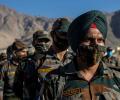
A joint statement released on Thursday said both sides exchanged views in an 'open and constructive' manner to resolve the 'relevant issues' and that it was agreed to maintain 'security and stability' on the ground in the region.

Lisa Curtis, who served as deputy assistant to President Trump and as National Security Council senior director for South and Central Asia from 2017 to 2021, said she expected the same bumps for India and the US, as in Trump's first term, including tariff, dependence on Russia over arms supply and oil purchase from Iran. Curtis, however, said both countries could never enter an alliance but develop a partnership that is "short of an alliance". She hoped them to achieve a cooperation that deters China, but also prepares both countries in case of a crisis or conflict, be it in the Taiwan Strait, the South China Sea, or another flare-up on the India-China border.

China does not have to give up what it took in 2020, it will never give up its claim to Arunachal Pradesh, Ladakh and other areas, and it has all the time now to plan its next surprise, points out Lieutenant General Prakash Katoch (retd).

He said China has accrued significant capacities for force mobilisation, application, and sustenance of military operations and maintained the long-pending boundary issue can not be divorced from bilateral relations between the two Asian giants.

Until Delhi and Beijing resolve outstanding border issues within an accelerated time frame, standoffs like Doklam will be repeated across various peaks along the Himalayas, says Mathew Maavak.
The talks till now have resulted in the resolution of issues in North and South Bank of Pangong Tso, Galwan and Gogra Hot Spring areas.
